CRE Portfolio Management Software 2026: Investment Analytics vs. Property Ops
CRE portfolio management software means two different products. Investment portfolio analytics (Solsten CRE, ARGUS Enterprise) models returns, GP/LP waterfalls, and investor reporting across a book of assets; property operations software (AppFolio, Buildium) handles rent collection, tenant billing, and maintenance, and MRI spans both. Decide which job you are hiring for before comparing the ten platforms below.
“CRE portfolio management software” means two completely different things depending on who is searching, and treating them as one category is why buyers end up with the wrong tool.
If you own or manage a book of commercial real estate assets, you are either trying to (a) analyze your portfolio’s investment performance, forecast returns, model distributions to LPs, and produce investor reports — or (b) collect rent, run tenant AR/AP, book journal entries, and manage day-to-day building operations. Both are legitimate work. They are almost never the same software.
This guide splits the 2026 landscape into those two categories so you can find the tool you actually need. Investment analytics platforms (Solsten, ARGUS, MRI Investment) sit on one side. Property operations platforms (AppFolio, RealPage, Buildium, Stratafolio) sit on the other. A few enterprise suites straddle both at enterprise pricing.
Investment Portfolio Analytics vs. Property Operations: Which Do You Need?
You want investment portfolio analytics software if you are doing this work:
- Projecting portfolio-wide cash flow across a multi-year hold period
- Modeling GP/LP distribution waterfalls with preferred return, catch-up, and promote tiers
- Producing quarterly investor reports and capital account statements for LPs
- Comparing IRR, MOIC, cash-on-cash, and DSCR across every property in the book
- Running exit scenarios and sensitivity analysis on multiple assets in parallel
- Generating an Offering Memorandum, Joint Venture packet, or Investor packet for a raise
- Comparing forecast versus actual performance across the portfolio, by period
You want property operations software if you are doing this work:
- Collecting rent, reconciling bank deposits, running AR/AP
- Booking journal entries in a general ledger
- Managing maintenance work orders and vendor payments
- Sending tenant billing statements and CAM reconciliations
- Handling day-to-day leasing paperwork and tenant applications
Some enterprise suites (MRI Software, parts of Yardi) do both — at enterprise pricing that puts them out of reach for most independent operators. Most tools specialize in one bucket, and asking a Yardi replacement to model your GP/LP waterfall — or asking an ARGUS replacement to book a rent payment — is where the wrong tool costs weeks.
Investment Portfolio Analytics & Reporting
Solsten CRE
Best For: Independent investors, syndicators, GPs, and mid-market firms who need institutional-grade portfolio analytics without institutional pricing Pricing: Free tier (1 property, 1 analysis/month, no credit card) + paid plans from $99/mo
Solsten is CRE portfolio management software built for the investment analytics side of running a book of properties. Model multi-property proformas, run 4-tier GP/LP distribution waterfalls with catch-up and promote, track individual investor capital accounts, project portfolio-wide cash flow across the hold period, and produce investor reporting exports — Offering Memorandum, Joint Venture packet, Investor packet — for every deal in the portfolio.
Portfolio investment analytics capabilities:
- 4-tier institutional GP/LP waterfall with configurable preferred return, catch-up, promote, and GP transaction fees
- Individual investor tracking with inline editing, capital account visibility, and per-investor distribution allocation
- Multi-property proforma engine — DCF, leveraged and unleveraged IRR, NPV, MOIC, cash-on-cash across every property
- Capital reserve management and forecasting across the portfolio
- Recovery modeling for NNN, base year stop, and modified gross recoveries across every asset
- Projected vs. actual variance analysis with period-level drill-down for asset management
- Timeline views for lease rollover, vacancy exposure, debt maturity, and operating pressure points across all assets
- ML-powered expense forecasting on every property
- PDF investor reporting exports — OM, JV packet, Investor packet — with underlying assumptions preserved
- Saga AI assistant for grounded Q&A on portfolio-level questions
Pros:
- Free tier gets you a full first portfolio analysis end to end — no credit card
- Institutional features (4-tier waterfall, multi-property DCF, LP reporting) at a fraction of ARGUS or MRI pricing
- Every calculation is transparent — public methodology at solstencre.com/how-solsten-calculates
- Veteran-owned, founder-built, frequent improvements
Cons:
- Not property operations software — no AR/AP, tenant billing, or GL accounting. You will still need Yardi, AppFolio, or Buildium for the ops side if you do property management in-house
- Newer market presence versus entrenched enterprise vendors
- Basic familiarity with financial concepts recommended
ARGUS Enterprise
Best For: Institutional CRE analysts, appraisers, and large firms with enterprise budgets Pricing: Enterprise ($5,000–$15,000+ per seat/year)
The long-standing industry standard for asset-level CRE valuation and cash flow forecasting. Used for deal underwriting, appraisal work, and institutional due diligence.
Pros:
- Market leader trusted by major CRE institutions
- Deep property-level valuation and forecasting depth
- Extensive reporting and scenario testing
Cons:
- Very expensive for small and mid-market firms
- Steep learning curve requiring formal training
- Asset-level focused — portfolio roll-up and LP reporting typically require separate tooling (ARGUS Intelligence, MRI, or custom)
MRI Software
Best For: Large firms managing complex multi-asset portfolios with institutional LPs, needing operations and portfolio management under one vendor Pricing: Enterprise (custom)
Enterprise CRE suite with unified leasing, finance, and investment management. 50+ years in market; 8,800+ commercial clients. One of the few platforms that handles both portfolio analytics and property operations under one roof — at enterprise price.
Pros:
- End-to-end portfolio + operations coverage under one vendor
- Deep integrations and configurability
- Managed services beyond just software
Cons:
- Complex setup and steep learning curve
- Enterprise pricing puts it out of reach for most independent operators and mid-market firms
- Long implementation timelines
Stessa
Best For: Individual real estate investors tracking a small personal portfolio Pricing: Free core; Pro ~$28/month
Investor-centric finance tracker with bank sync, expense capture, and Schedule E export for tax prep. Portfolio-level dashboards for individuals.
Pros:
- Free tier with core features
- Bank sync and automated expense capture
- Schedule E export for taxes
Cons:
- No GP/LP waterfall, no LP reporting, no institutional-grade analytics
- Better suited for individuals than firms
- Limited operational tooling on the ops side too
Property Operations & Lease Administration
AppFolio
Best For: Small to mid-size property managers wanting user-friendly automation Pricing: Tiered subscription
Clean, intuitive property management platform with strong automation. Handles rent collection, tenant billing, leasing workflow, and maintenance operations.
Pros:
- User-friendly UI, quick to learn
- Strong cloud and mobile experience
- Workflow automation reduces manual tasks
Cons:
- Property operations focused — no portfolio-level investment analytics or LP reporting
- Can be expensive for small operations
- Less flexibility for institutional investor reporting
RealPage Commercial
Best For: Commercial property management specialists Pricing: Per-square-foot model (custom)
Cloud-based property management for commercial and industrial assets with lease administration and property financial management.
Pros:
- Integrated leasing, accounting, and tenant tools
- Handles complex ops calculations (CAM, CPI, percentage rent)
- Document management and compliance features
Cons:
- Property operations focused — not built for investor reporting or portfolio analytics
- Pricing requires consultation; hidden fees reported
- Users note occasional slowness and support quality concerns
Buildium
Best For: Small to medium property managers (10–500 units) Pricing: Starting at ~$58/month
Cloud property management spanning residential and commercial with day-to-day operational tools.
Pros:
- Affordable plans accessible to small firms
- Mixed residential + commercial friendly
- Solid ops-side financial reporting
Cons:
- No portfolio-level investment analytics, waterfall, or LP reporting
- Less depth for CRE-specific ops
- Advanced features gated behind higher plans
Stratafolio
Best For: Commercial property owners already using QuickBooks Pricing: Subscription (requires QuickBooks)
Commercial-first lease management with deep two-way QuickBooks integration and portfolio visibility on the ops side.
Pros:
- Best-in-class two-way QuickBooks sync
- Purpose-built for CRE lease workflows
- Automation reduces manual bookkeeping errors
Cons:
- Requires active QuickBooks subscription
- Lease-ops focused; no investment analytics, waterfall modeling, or LP reporting
- Limited pricing transparency
MonkSpaces.ai
Best For: Residential property managers seeking AI-powered tenant engagement Pricing: Per-unit pricing
AI-powered platform geared toward residential operations with automation, multi-channel communications, and tenant experience features.
Pros:
- AI features reduce manual work
- Multi-channel communications and custom apps
- Strong amenity management tools
Cons:
- Primarily residential, not CRE-focused
- Not portfolio management in the investment analytics sense
- Limited track record and integrations
InsightSoftware — Real Estate Manager
Best For: Enterprise corporate occupiers with ASC 842 / IFRS 16 compliance needs Pricing: Custom enterprise pricing
Enterprise lease accounting for corporate occupiers with 140+ ERP/EPM integrations.
Pros:
- ASC 842 and IFRS 16 compliance support
- 140+ ERP/EPM integrations with real-time data feeds
- Built for enterprise-scale governance
Cons:
- Corporate occupier focused — not owner or investor portfolio analytics
- Custom pricing can be high
- Overkill for basic portfolio needs
Quick Pick Guide
| You need | Best match |
|---|---|
| Free-tier start, portfolio investment analytics, GP/LP waterfalls, investor reporting | Solsten |
| Institutional asset-level valuation and forecasting | ARGUS Enterprise |
| End-to-end portfolio + operations under one enterprise suite | MRI Software |
| Individual investor portfolio tracking with Schedule E export | Stessa |
| Property operations — rent collection, tenant billing, maintenance | AppFolio or Buildium |
| CRE lease ops with QuickBooks integration | Stratafolio |
| Corporate occupier lease accounting (ASC 842 / IFRS 16) | InsightSoftware |
| Enterprise commercial property management | RealPage Commercial |
FAQs
What is the difference between portfolio management software and property management software? Portfolio management software (in the investment analytics sense) covers portfolio-level cash flow forecasting, GP/LP distribution modeling, investor reporting, IRR and MOIC comparison across deals, and exit scenario planning. Property management software (operations) covers rent collection, tenant billing, general ledger accounting, and day-to-day building operations. Solsten, ARGUS, and MRI Investment focus on the analytics side. AppFolio, RealPage, Buildium, and Stratafolio focus on the operations side. A few enterprise suites — MRI, parts of Yardi — cover both at enterprise pricing.
We already use ARGUS Enterprise. What is the next step for portfolio-level insight? ARGUS Enterprise is asset-level valuation software. For portfolio-level distribution modeling, LP reporting, and cross-property performance analysis, most firms pair ARGUS with a portfolio layer — options include MRI Investment Central, Solsten, or CREModels. Solsten’s advantage is running the full asset-level DCF and the portfolio waterfall / LP reporting in one platform at mid-market pricing.
Does Solsten replace Yardi, AppFolio, or RealPage? No. Solsten does not do property operations — no AR/AP, tenant billing, general ledger, or maintenance workflows. If you need those, Yardi Voyager, AppFolio, RealPage Commercial, or Buildium is the right tool. Solsten is for the investment analytics side of managing a portfolio: multi-property forecasting, GP/LP waterfall modeling, investor reporting, and exit scenario planning.
Which platform is best for corporate occupiers, not landlords? InsightSoftware and MRI Software both have strong lease accounting and compliance modules designed for corporate occupiers managing their real estate footprint.
What is the difference between investment management and asset management software? Investment management focuses on portfolio-level returns, LP reporting, and capital deployment across deals. Asset management focuses on property-level performance monitoring — variance analysis, lease rollover management, and operating pressure points on individual assets. Solsten covers both — the asset management workflow for individual property monitoring, and portfolio-level waterfall and investor reporting tools for the investment management layer.
Related Articles
- Waterfall Distributions Explained — How equity waterfalls work for LP/GP fund structures
- ARGUS vs Solsten: Feature-by-Feature Comparison — Honest look at where each platform excels
- Solsten vs Excel: Why Spreadsheets Break CRE Underwriting — Purpose-built proformas vs. brittle formulas
- Best Free Commercial Property Valuation Tools (2025) — Free alternatives to paid platforms
- Best Valuation Tools, Cap Rate Calculators & Strategy Guide — Cap rate tools and investment strategy
Explore Solsten
- CRE Portfolio Software — Solsten’s fund-level view: ownership-weighted KPIs, combined operating statement, fund waterfall, LP logins
- Waterfall Distribution Modeling — 4-tier GP/LP structures with catch-up and promote
- ARGUS Alternative — Institutional analytics at mid-market pricing
- All Features — Proformas, ML forecasting, waterfalls, and portfolio tools
- Plans & Pricing — Start for free, scale as your portfolio grows
Try Solsten Free
See everything we discussed in action — no credit card required.
Start Your Free AnalysisRelated Articles
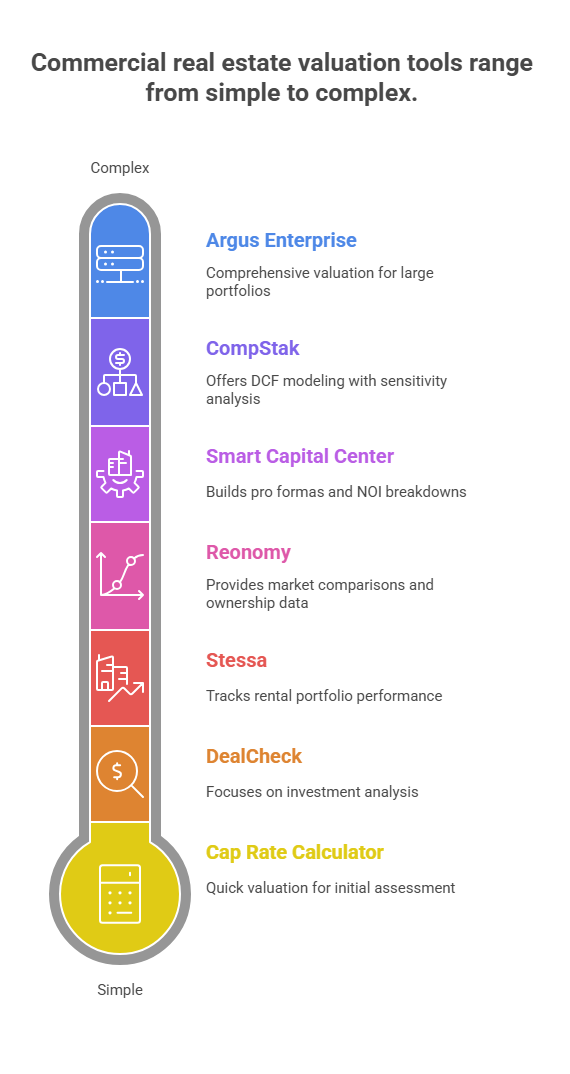
The 8 Best Free Commercial Property Valuation Tools (2026)
We tested 8 free commercial property valuation tools. What each free tier really includes, where the paywalls hide, and a side-by-side comparison table.
ARGUS Enterprise End of Life: Every Date, and What Each One Actually Means
ARGUS Enterprise version 13 comes off ARGUS Cloud on 31 December 2026. Here are the dates Altus published, what each one changes in practice, and what your options are if you are still on it.
ARGUS vs Solsten: A Feature-by-Feature Comparison for CRE Professionals
Detailed feature-by-feature comparison of ARGUS Enterprise and Solsten for CRE analysis. See where each platform excels, pricing differences, and which is right for your workflow.