DSCR Formula in Commercial Real Estate: 2026 Lender Requirements & Calculator
The debt service coverage ratio (DSCR) is net operating income divided by annual debt service, principal plus interest. A DSCR of 1.25x means the property earns $1.25 for every $1.00 of loan payments. Most commercial lenders require at least 1.25x, from 1.20x for multifamily to 1.50x for hotels and construction. Solsten CRE calculates DSCR for every loan in every year.

Before any commercial real estate lender writes a check, they answer one question: can this property’s income cover the mortgage payments? The Debt Service Coverage Ratio (DSCR) provides the answer.
DSCR is the single most scrutinized metric in CRE lending. It determines how much you can borrow, what interest rate you’ll pay, and whether your loan stays in compliance after closing. This guide covers the formula, what lenders require, and how to structure deals that clear the bar.
The DSCR Formula
Annual debt service = total principal + interest payments for the year (not just interest).
| DSCR | Meaning |
|---|---|
| > 1.0 | Property income covers debt payments with room to spare |
| = 1.0 | Income exactly equals debt payments — no cushion |
| < 1.0 | Income doesn’t cover debt — owner dips into reserves or equity |
A DSCR of 1.25× means the property earns $1.25 for every $1.00 of debt service. That extra $0.25 is the lender’s safety cushion.
DSCR Calculation Example
Property details:
- Net Operating Income: $350,000/year
- Loan amount: $3,500,000
- Interest rate: 6.25%
- Amortization: 30 years
- Annual debt service: $258,552
This property generates 35% more income than needed to service the debt — well within most lender requirements.
What If NOI Drops?
Now imagine a major tenant vacates and NOI falls to $240,000:
Below 1.0× — the property can’t cover its debt from operations alone. The owner needs to inject cash, draw on reserves, or face a covenant violation.
What Lenders Require
DSCR requirements vary by property type, lender, and market conditions:
| Property Type | Typical Minimum DSCR | Why |
|---|---|---|
| Multifamily | 1.20–1.25× | Stable, diversified tenancy |
| Office | 1.25–1.35× | Longer vacancy exposure |
| Retail | 1.25–1.40× | Tenant credit risk varies |
| Industrial | 1.20–1.30× | Strong demand, low vacancy |
| Hotel | 1.40–1.50× | Revenue volatility |
| Construction | 1.30–1.50× | No income during build |
Key points:
- These are minimums — many lenders underwrite to 1.30× or higher
- CMBS loans often have stricter DSCR covenants than bank loans
- SBA 504 loans may accept lower DSCR (1.15×) for owner-occupied properties (program terms at SBA.gov)
- Agency multifamily lenders publish their sizing standards in the Fannie Mae Multifamily Guide and Freddie Mac Multifamily seller/servicer materials; banks and CMBS lenders set their own, so confirm the minimum with the lender before you size the loan
- Higher-risk properties or markets push requirements higher
How DSCR Constrains Loan Amount
Lenders use DSCR to back into the maximum loan size. This is the DSCR-constrained loan amount:
Step-by-Step: Maximum Loan Sizing
Given:
- NOI: $350,000
- Required DSCR: 1.25×
- Interest rate: 6.25%
- Amortization: 30 years
Step 1: Maximum allowable debt service
Step 2: Convert to maximum loan amount
Using a 30-year amortization at 6.25%, the annual debt service constant is approximately 7.39% of the loan balance:
Step 3: Compare with LTV constraint
If the property is appraised at $5,000,000 and the lender allows 75% LTV:
The lender uses the lower of the two: $3,750,000 (LTV controls). In other deals, DSCR may be the binding constraint — especially when cap rates are low (high prices) but rents haven’t caught up.
DSCR vs. LTV: Which Controls?
Both DSCR and Loan-to-Value (LTV) constrain the loan. The binding constraint depends on market conditions:
| Market Condition | Binding Constraint | Why |
|---|---|---|
| Low cap rates (expensive properties) | DSCR | High prices relative to income |
| High cap rates (cheaper properties) | LTV | Income supports more debt than value allows |
| Rising rates | DSCR | Debt service increases faster than NOI |
| Strong rent growth | LTV | NOI grows, improving DSCR beyond LTV limit |
In today’s higher-rate environment, DSCR is more frequently the binding constraint. Borrowers who previously qualified at 75% LTV may find DSCR limits them to 65–70% effective leverage. Fixed-rate CRE loans price off a Treasury or swap rate matching the loan term, with the 10-year Treasury yield (FRED series DGS10) as the common reference. When it rises, the loan constant rises with it, and DSCR tightens before LTV does.
Interest-Only Periods and DSCR
Many commercial loans include an interest-only (I/O) period (typically 1–3 years) before principal payments begin:
| Period | Annual Debt Service | DSCR |
|---|---|---|
| Interest-only (Year 1–2) | $218,750 | 1.60× |
| Amortizing (Year 3+) | $258,552 | 1.35× |
Lenders typically underwrite to the amortizing DSCR, not the I/O period. Don’t mistake the higher I/O-period DSCR for the true coverage — it tightens significantly once principal payments start.
DSCR Over the Hold Period
DSCR isn’t static. It changes every year as NOI grows (or shrinks) while debt service stays relatively constant:
| Year | NOI | Debt Service | DSCR |
|---|---|---|---|
| 1 | $350,000 | $258,552 | 1.35× |
| 2 | $360,500 | $258,552 | 1.39× |
| 3 | $371,315 | $258,552 | 1.44× |
| 5 | $394,074 | $258,552 | 1.52× |
| 7 | $417,933 | $258,552 | 1.62× |
With 3% annual NOI growth and fixed-rate debt, DSCR improves steadily. This is one reason value-add investors accept thin Year 1 DSCR — they project improvement as rent stabilizes.
When DSCR Deteriorates
Watch for scenarios where DSCR trends downward:
- Major tenant expiration without renewal certainty
- Below-market rent resets on renewal
- Rising expenses outpacing rent growth
- Variable-rate debt with rising index rates
- Deferred maintenance leading to occupancy loss
A declining DSCR trajectory is a red flag for both lenders and investors.
DSCR Loan Covenants
Most commercial loans include ongoing DSCR covenants — not just at origination:
| Covenant | Typical Threshold | Consequence of Breach |
|---|---|---|
| Minimum DSCR | 1.10–1.20× | Cash sweep, lockbox activation |
| Hard lockbox trigger | 1.00–1.10× | All income goes to lender-controlled account |
| Event of default | < 1.00× | Loan acceleration risk |
Cash sweep: Property income above debt service goes into a lender-controlled reserve instead of to the borrower. This protects the lender but eliminates investor distributions.
How to Improve DSCR
If your DSCR is tight, there are two levers — increase NOI or decrease debt service:
Increase NOI
- Lease vacant space at market rates
- Push rents to market on renewals
- Add revenue streams (parking, storage, signage)
- Reduce operating expenses (renegotiate management, insurance, maintenance contracts)
- Improve recovery structures (convert gross leases to NNN/modified gross)
Decrease Debt Service
- Increase amortization period (25 → 30 years)
- Buy down the rate (pay points upfront)
- Reduce loan amount (higher equity contribution)
- Interest-only period (temporary relief, doesn’t change amortizing DSCR)
- Refinance if rates have dropped
Automating DSCR Analysis
Manually calculating DSCR for one year is straightforward. Projecting it over a 7–10 year hold period with changing occupancy, rent escalations, expense inflation, and refinancing scenarios is where complexity explodes.
Solsten calculates DSCR automatically as part of the full proforma — with amortization schedules, refinance modeling, and variable occupancy built in. The 15-factor risk scoring system includes DSCR alongside LTV, WALT, break-even occupancy, and tenant concentration so you see the complete risk picture, not just one ratio.
Key Takeaways
- DSCR = NOI ÷ Annual Debt Service — measures how well income covers mortgage payments
- Most lenders require 1.25× minimum; riskier properties need higher DSCR
- DSCR and LTV together constrain loan size — the stricter one controls
- Always underwrite to the amortizing DSCR, not the interest-only period
- DSCR should improve over time with rent growth; declining DSCR is a warning sign
- Breach of DSCR covenants triggers cash sweeps or even loan acceleration
Related Articles
- CRE Loan Types Explained — CMBS, SBA 504, bank loans, and bridge financing compared
- What Is NOI in Commercial Real Estate? — NOI is the numerator in DSCR — get it right
- How to Build a Real Estate Proforma — Full proforma walkthrough including debt service and DSCR
- Commercial Real Estate Cash Flow Analysis — What a 6 percent NOI miss does to cash flow and coverage once the loan is in place
- Cap Rates: Do They Really Matter? — How cap rates interact with DSCR and leverage
- Solsten CRE Financing Index — This quarter’s Treasury curve, SOFR, loan constants, and the DSCR-constrained LTV table, from Federal Reserve data
Explore Solsten
- 15-Factor Risk Scoring — DSCR is one of 15 weighted risk factors Solsten evaluates
- CRE Proforma Software — Operating statements with automated DSCR tracking
- ARGUS Alternative — Multi-loan debt modeling and DSCR analysis at a fraction of enterprise seat pricing
- All Features — Proformas, forecasting, risk scoring, and financing analysis
- Plans & Pricing — Start your analysis for free
Frequently asked questions
- What is the DSCR formula?
- Debt service coverage ratio equals net operating income divided by annual debt service, where debt service is total principal and interest for the year, not interest alone. A property with $350,000 of NOI and $258,552 of annual debt service has a DSCR of 1.35x.
- What DSCR do commercial lenders require?
- Minimums vary by property type: roughly 1.20x to 1.25x for multifamily, 1.25x to 1.35x for office, 1.25x to 1.40x for retail, 1.20x to 1.30x for industrial, 1.40x to 1.50x for hotels, and 1.30x to 1.50x for construction loans. Many lenders underwrite to 1.30x or higher, and CMBS covenants are often stricter than bank loans.
- What happens if DSCR falls below 1.0?
- The property cannot cover its debt service from operations, so the owner must inject cash or draw reserves. Loan covenants typically trigger a cash sweep at 1.10x to 1.20x, a hard lockbox at 1.00x to 1.10x, and an event of default below 1.00x, which carries loan acceleration risk.
- How does DSCR limit the loan amount?
- Divide NOI by the required DSCR to get maximum debt service, then divide by the loan constant for the rate and amortization. With $350,000 of NOI, a 1.25x requirement, and a 6.25 percent 30-year loan (constant about 7.39 percent), the DSCR-constrained loan is about $3,789,000. The lender then takes the lower of the DSCR-constrained and LTV-constrained amounts.
- Do lenders underwrite to the interest-only DSCR?
- No. Lenders underwrite to the amortizing DSCR. An interest-only period shows a higher coverage ratio (1.60x versus 1.35x in the guide's example) that tightens as soon as principal payments begin.
- How can I improve DSCR?
- Raise NOI by leasing vacant space, pushing renewals to market, adding income streams, cutting operating expenses, or converting gross leases to NNN or modified gross. Or lower debt service by extending amortization, buying down the rate, borrowing less, or refinancing when rates fall. An interest-only period gives temporary relief but does not change the amortizing DSCR.
Try Solsten Free
See everything we discussed in action — no credit card required.
Start Your Free AnalysisRelated Articles
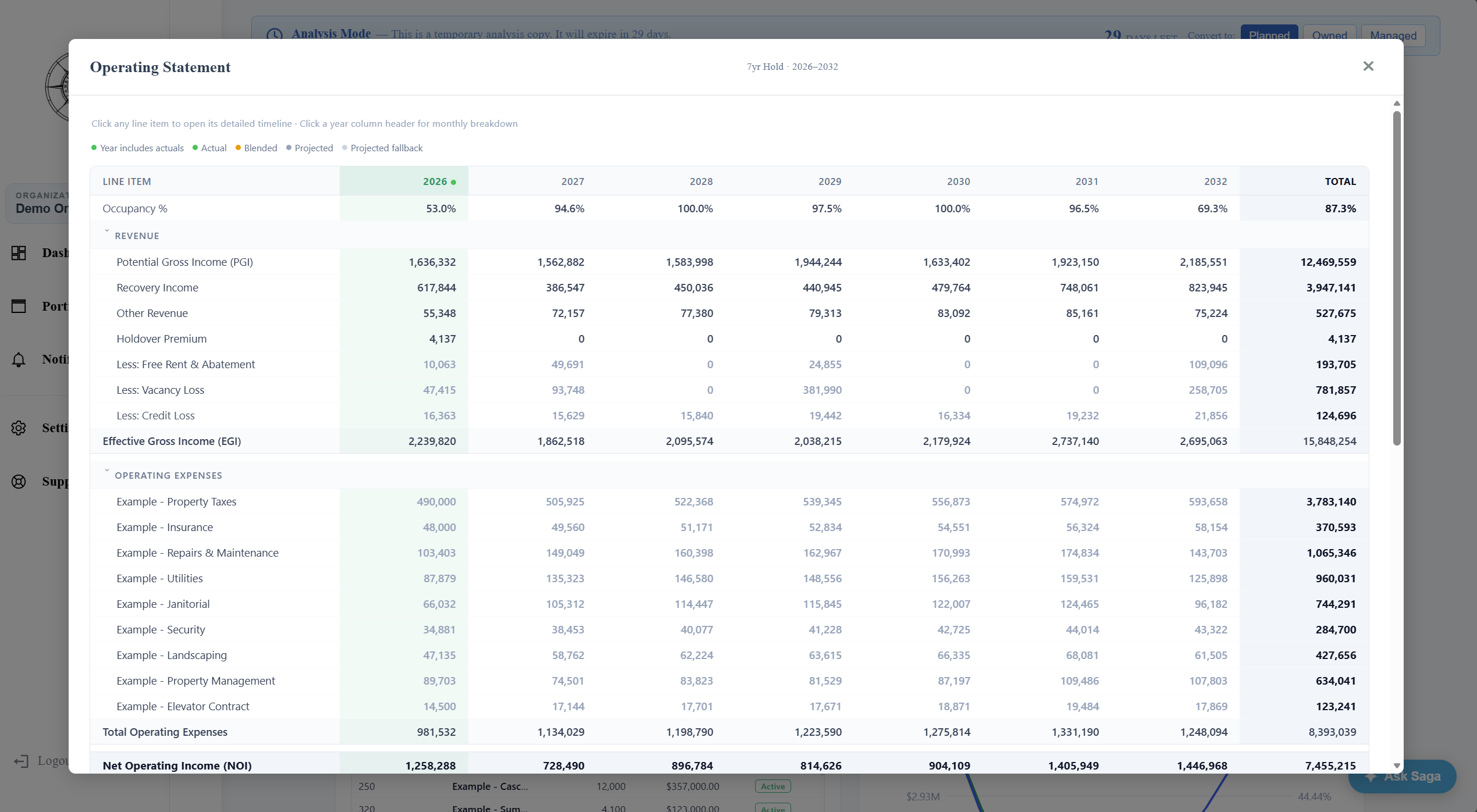
Commercial Real Estate Cash Flow Analysis: From NOI to Cash-on-Cash
Commercial real estate cash flow, step by step: PGI to distributable cash, a worked office example with debt service and reserves, why monthly matters, and five mistakes to avoid.
How to Value an Income Property with Solsten's Free Tier
A practical walkthrough of NOI, cap rate, and DSCR math for income properties, worked through Solsten's free tier — the free CRE valuation platform for investors who want institutional math without ARGUS pricing.

What Is NOI in Commercial Real Estate? The Complete Guide
Net Operating Income (NOI) explained — formula, calculation examples, what to include and exclude, and how NOI drives cap rates, debt sizing, and property valuation.